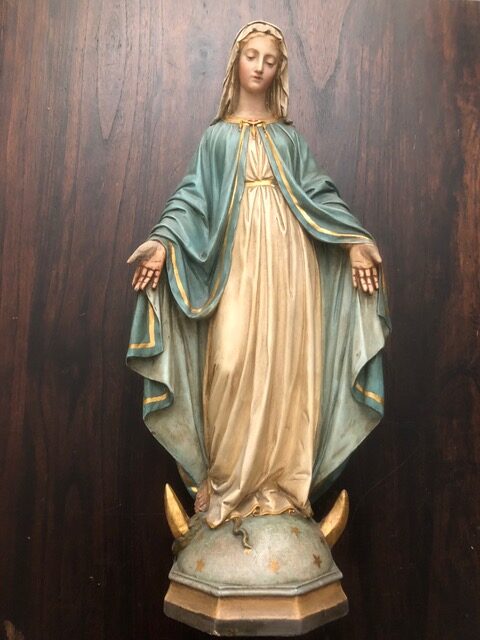
In the Catholic Church, 1 January is the Solemnity of Mary, the Mother of God. This day also marks the close of the Octave of Christmas. This eight-day period begins on 25 December, Christmas Day, and ends on 1 January with the feast day of Mother Mary.
The first day of the year is the start of a new calendar year under the protection of Mary as Mother. This places the new year under Mary's maternal care and marks the beginning of a new era.
In 553, the Mother of God and her perpetual virginity were discussed. This took place at the Second Council of Constantinople, which is the fifth Ecumenical Council. The gathering of high-ranking clergymen was convened by Justinian I, born Petrus Sabbatius (482-565), Roman Emperor from 527 to 565. The reason for the council was to achieve clarity and agreement among the clergy that Mary had brought forth the divinely incarnated Word into the world. Mary's position as “Theotokos” was definitively established in 553. Clarity and agreement were necessary because the Council of Chalcedon in 451 had led to more than one interpretation. At Chalcedon, it was determined that Jesus is the second person of the Holy Trinity, existing in two natures, namely fully divine and fully human, which are united in one person. Monophysites, followers of Monophysitism, assert that Jesus Christ has one nature (Greek: “mia physis”), which is a god-man nature. In 553, a schism was averted, but in 555, churches in Africa and what is now Italy lost confidence in Pope Vigilius I, who served as Pope from 537 to 555. This situation persisted until the year 700. The Fifth Ecumenical Council was later recognised by the Roman Catholic Church and the Eastern Orthodox Churches.
In the 7th century, January 1st was already the date for the celebration of Mary's Motherhood.
Mary is the Holy Virgin, Mother of Christ. He is both God the Son and as a human, Jesus of Nazareth. Much of what a child is and has comes from the mother. This creates a lifelong bond between mother and child. This is also the case between Mary and Jesus.
Pius XI, Pope from 1922 to 1939, born Ambrogio Damiano Achille Rati (1857-1939), decreed that the feast of Mary Mother of God should be celebrated on 11 October. The date of 11 October reaffirms the dogma of Mary Mother of God (Theotokos) at the Council of Ephesus in 431. Since this great church council, the title Mary Mother of God has been used for the Woman who gave birth to her Child at Christmas.
The date of the feast day of 11 October is changed by Paul VI, Pope from 1963 to 1978, born Giovanni Battista Enrico Antonio Maria Montini (1897-1978). He moves the feast day to 1 January. This is eight days after Mary's delivery, and then the Circumcision of her Child takes place. The newborn then receives the name Jesus.
In Eastern churches, the feast day of Mary, Mother of God falls on 26 December.
~~~
