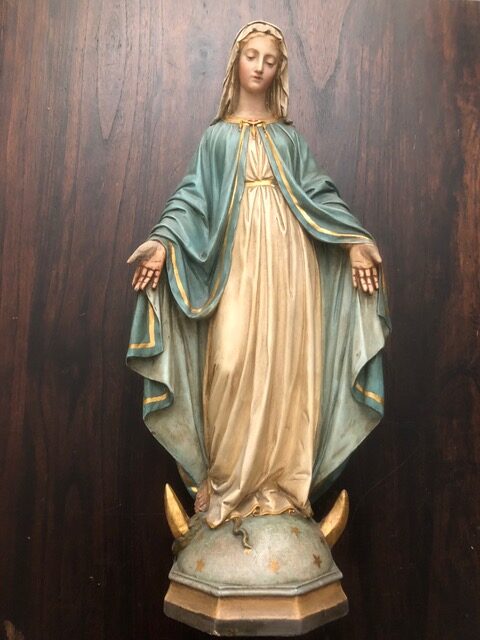
Many believers are given the name Maria at birth. This is due to the influence of this name on people. This is partly because Maria is seen as the Mother of everyone, there is a lot of attention paid to Maria, her history, pilgrimage sites, and many chapels dedicated to her. Worldwide, many people bear the name Maria, and this is also the case in quite a few languages. The name Maria is therefore a classic, timeless name that has been popular since biblical times.
In Maria's mother tongue, Aramaic, the name is Maryam. In Greek, the language in which the New Testament was written, names for Maria and Mariam appear. In Hebrew it is Mirjãm. This name appears as the sister of Moses and Aaron. In the Dutch language, many nicknames are derived from Maria, such as Marian, Marianne, Marie, Marie-Antoinette, Marieke, Marijke, Mariken, Marjan, Mia and Ria.
Originally, Maria is an Egyptian name and means beautiful, well-formed, and star of the sea. Maria is beloved by the Egyptian god Amon. The name Maryam can also have Egyptian origins and means “beloved”.
In the 4th century, there was Eusebius Sophronius Hieronymus (c. 347-420), also known as Jerome of Stridon, a writer, translator, and church father, who translated the Bible into the Latin vernacular between 390 and 405. He stated that the name Mary means “drop of the sea.” This is “Stilla Maris” in Latin. Due to an oversight, this was transcribed as “Stella Maris,” meaning “star of the sea.” During the Council of Trent (1545-1563), Jerome's text was accepted as authoritative.
In the final centuries of the Roman Empire, the name Mary appears rarely, if at all. This also applies to the early medieval period.
From the 12th century onwards, the bearing of the name Maria took off in a big way. In those times, legends about Maria were also told and miracle plays emerged in which Maria held a prominent position. Particularly from this time onwards, Maria was seen as a mediator between people and Jesus. It is striking that in those years, it was many noblewomen, including countesses, duchesses, princesses, and queens, who bore the name Maria.
In the miracle play from circa 1515, “Mariken van Nieumeghen” (Mariken of Nijmegen), written by an unknown author, the name Mariken, derived from Maria, is used. The core of the story is that the devil helps Mariken and she decides to follow him. The devil sets two conditions: never to make the sign of the cross again and to adopt another name. The devil demanded this of her because he had experienced misfortune due to a certain Maria. The name Maria and names derived from it are no longer tolerated by the devil. Mariken complies with the first condition but not the second. She keeps her name, which comes from Maria, and this offers her hope and comfort. The moral of this story is that no matter how much someone sins, there is always forgiveness through Maria, provided repentance is shown.
The name and image of Mary are frequently present. Places, buildings, statues, and churches bear her name. Examples of places named after Mary include: Mariakerke, Sint-Maria-Latem, and Onze-Lieve-Vrouw van Waver. Some examples of churches that refer to Mary in their name are: the Church of Our Lady Immaculate Conception in Dadizele, the Church of the Assumption of Mary in Kortenbos, the Basilica of Our Lady in Scherpenheuvel, Our Lady of Peace in the St. Nicholas' Church in Brussels, and the Church of Our Lady of Lourdes in Bergen op Zoom.
From the 19th century onwards, the name Maria and derivatives of it became increasingly popular. For many years, it was the name most frequently given to newborn girls, and many boys also had Maria as one of their baptismal names.
