~~~
History
The present-day city of Częstochowa originated in the 11th century. A charter from 1220 mentions the village of Tschenstochau for the first time. Later, the name becomes Altes Tschenstochau and subsequently Czestochowa.
In 1382, Wladyslaw II Opolczyk (1332-1401), Duke of Opole (1356-1396), had a monastery built on Jasna Góra (Bright Mountain) for monks of the “Order of Saint Paul the First Hermit”. These are followers of Saint Paul of Thebes (c. 227-c. 341); the Pauline Fathers are the only indigenous order from medieval Hungary. The site on the mountain would eventually become a very popular pilgrimage destination. High-ranking citizens, pilgrims, and nobles, including kings, gave gifts such as money and precious stones. This enabled the construction of a fortress with high walls on Jasna Góra. The Duke donated an icon, which he had brought from Ukraine, to the monastery. He stated that it was a work by the evangelist Luke. The story of the icon continued, relating that the artwork travelled from Jerusalem to the Emperor of the Holy Roman Empire, and was now on the mountain.

In a document from 1388, “Jasna Góra” (Shining Mountain) is mentioned for the first time. In 1382, the icon of grace arrived at the church on the mountain.
In 1430, a band of Hussites raided the monastery. This was a Protestant group whose members were followers of the theologian Johannes Hus (1369-1415). Ex votos were stolen and the statue of grace was damaged.
The monastery complex is largely from the 17th century. The buildings are surrounded by massive bastions. The thick defensive walls protect the sanctuary from unwanted intruders. One of the four entrance gates is the “Brama Walowa/Jagiellonów” (“Gate of Our Lady of Sorrows”).
In 1641–1644, the Chapel of the Mother of God was expanded due to the increasing number of pilgrims. The high altar in this chapel was made in 1645–1650. The design is by the Italian Baroque architect Giovanni Battista Gisleni (1600–1672). The altar is a gift from Jerzy Ossoliński (1595–1650), Chancellor (1643–1650).
The Chapel of Our Lady of Częstochowa (Kaplica Matki Boskiej) dates from 1650, as does the altar. It houses the Black Madonna; the most revered image of Mary with Child in Poland.

In 1655, Swedish troops violently invaded Poland and conquered a large part of the country. The monastery of Jasna Góra offered resistance and held out under the leadership of Prior Augustyn Kordecki (1603-1673). The siege by the Swedes lasted 6 weeks. Because Jasna Góra was not captured, its popularity grew. Believers saw the resistance against the Swedes as a miracle of Mary. Thus, a myth of the invincibility of the Black Madonna was born. This led to a surge in Marian devotion. On April 1, 1656, Jan II Kazimierz Vasa (1609-1672), King of Poland (1648-1668), entrusted his country to the care of the Mother of God. Mary then became the patroness and queen of Poland. Jasna Góra thus became the symbol of national independence and the religious heart of the Polish people.
After a fire in 1690, the church was restored and decorated with a Baroque interior. This took place between 1690 and 1695.

The presbytery was made between 1693 and 1695. The painter Karl Dankwart (+1704), from Sweden, embellished it. The high altar dates from 1728 and depicts the Assumption of Mary.
On 8 September 1717, the Black Madonna was crowned Queen of Poland.
The basilica's main altar dates from 1728.
In 1770-1771, Russian troops attempted to seize the monastery but were unsuccessful. In 1772, after negotiations, the fortress was handed over to the Russians. Following this, Polish territory was divided. In 1792, Cossacks murdered all the pilgrims present. After the second partition of the country in 1793, the Prussians occupied the complex. During the third partition of Poland, Poland disappeared from the map for over 100 years. The image of Mary became the symbol for a free Poland. In 1806, French troops took control of the monastery complex and looted ex-votos and other valuable works. After the French, the Russians returned to power. The sanctuary had no valuable works left.

In 1906 the church received the title of basilica.
As the crowns of the image of grace have been stolen, a new coronation will take place on May 22, 1910. The crowns were donated by Pius X, Pope 1903-1910, born Giuseppe Melchiore Sarto (1835-1914).
In 1913, a Way of the Cross was erected on the sanctuary grounds with large bronze statues. The sculptor was Pius Welonski (1849-1931), and he collaborated on this with architect Stefan Szyller (1857-1933).
On 27 July 1920, Maria is re-elected Queen of Poland as the Russians invade Poland again.
In 1921-1929, the Mariazaal, situated next to the Walpoort, was built for exhibitions.
During the Second World War (1939-1945), part of the complex was occupied by Germans. Pilgrimages were forbidden at that time.
A copy was made of the image of grace, and this was blessed by Pius XII, Pope from 1939 to 1958, born Eugenio Maria Giuseppe Giovanni Pacelli (1876-1958). Subsequently, the effigy made a tour of Poland for 23 years.
In 1982, the museum for the monastery's 600th anniversary was opened.

On 4 June 1979, John Paul II, Pope 1978-2005, born Karol Józef Wojtyla (1920-2005), visited the shrine and brought a golden rose as a gift. The Pope was born in Wadowice, which is close to the shrine. The Pope's second pilgrimage took place from 18 to 21 June 1983. On 12 and 13 June 1987, the Pope visited Jasna Góra for the third time. His fourth pilgrimage was from 14 to 16 August 1991. On 4 June 1997, Pope John Paul II visited the shrine once more. He brought a golden rosary for the Chapel of the Mother of God. The sixth and final pilgrimage of the Polish Pope to Jasna Góra was on 17 June 1999.
In 2001, Jerzy Duda Gracz (1941-2004) painted the stations of the cross.
Twenty stations of the “Mysteries of the Rosary” were erected in 2005. The bronze statues on marble plinths were initially created by Józef Marek (1922-2020) and the work was then continued by Tomasz Ross (1966).
On 27 February 2006, Benedict XVI, Pope from 2005-2013, born Joseph Aloisius Ratzinger (1927-2022), decided to visit the shrine and bring the Golden Rose of Pope Paul VI with him. This rose was supposedly brought to Jasna Góra as early as 1966. Paul VI was Pope from 1963 to 1978 and was born Giovanni Battista Enrico Antonio Maria Montini (1897-1978). All this time, the rose had been in the Vatican museum. On 26 May 2006, this Pope was at the shrine and brought the promised rose for Poland's greatest pilgrimage site.
Pilgrimage site
In Poland, Czestochowa is the pilgrimage site with the most visitors per year. It is the largest Marian sanctuary in Central and Eastern Europe. Approximately 4 million visitors come here annually.

Atop the Jasna Góra hill lies the end of the 2 km long “Aleja Najświętszej Maryi Panny” (“Avenue of the Most Holy Virgin Mary”), where visitors to the city arrive at the Jasna Góra Monastery with its basilica, the religious centre of Poland.
From a great distance, the towers of the basilica can be seen. The basilica's tower measures 106 metres and is the tallest church tower in Poland.
Four gates provide access to the monastery grounds, including that of the Triumphant Madonna, the Queen of Poland, and that of the Our Lady of Sorrows.

The main nave of the basilica is 46 metres long, 21 metres wide and 29 metres high, and features many frescoes. There are also paintings in the chancel. The high altar is lavishly gilded with an image of the Assumption of Mary. Within the basilica are the Dönhoff Chapel, Jablonowski Chapel, treasury, and sacristy, among other things. The library is not accessible to pilgrims.
The most significant aspect of the shrine is the Chapel of Our Lady of Czestochowa (Jasna Góra). It contains several altars, such as the altar with the image of Our Lady, the altar of the Sorrowful Mother, the altar of Mary's journey to the Temple, that of Mary's visit to her cousin Elizabeth, the altar of the Annunciation by the angel that Mary will become pregnant, and the altar of Mary's birth. In a side chapel of the basilica hangs the painting of Mary and Jesus. There are daily services here. Many a pilgrim goes on their knees to the icon of Mary and her Son. It is said that the image was painted by the apostle Luke, who lived in the house where Mary, with Joseph and Jesus, resided. This is the traditional version. This painting travelled from Jerusalem to Emperor Constantine the Great, born Flavius Valerius Aurelius Constantinus (c.273-337), sole emperor of the Roman Empire (324-337). The painting depicts a Black Madonna, painted on a wooden panel. Duke Wladyslaw Opolczyk brought it from Ukraine to the monastery on Jasna Góra. Specialists in icon art believe it to be a Byzantine work created between the period of 500-800 and that it could not have been painted by Luke. Miracles are attributed to the icon, such as the victory over the Swedes. The painting symbolises the sovereignty and freedom of Poland. It is the most revered image of Mary with Child in Poland. People not only from Poland but from all over the world come here.

The depiction of the well-known painting of the Mother of God is made on three linden wood panels and is a total of 122 cm high, 81 cm wide, and almost 4 cm thick. The icon is named “Hodegetria”, a Greek word meaning “She who shows the way”. Mary is depicted in a standing position with her Son on her left arm, and she looks towards the visitors. Her right hand rests on her chest and points to her Child. Mary wears a dark blue robe, adorned with many golden lilies. A hexagonal star is visible above her forehead. The young Jesus wears a red robe. In his left hand, he holds a book, and his other hand makes a gesture of blessing. Mary and Jesus have a dark complexion, which is why Mary is referred to as the Black Madonna. Their heads are surrounded by a golden halo. The background behind Mary and Child is greenish.
To the left of the Black Madonna, royal regalia can be seen, including a sceptre and an orb, as well as gifts from Polish women in 1926. To the right of the renowned image of Mary is a golden rose, a gift from Pope John Paul II in 1979. Many ex-votos adorn the chapel. On this side, a heart is also visible with the Latin words “totus tuus”, which means “entirely yours”. It is a gift from Pope John Paul II. Also from this Pope, a belt from a toga stained with blood can be seen; this was worn by him on 13th May 1981 when an assassination attempt was made on him in St. Peter's Square in Rome.
Maria's clothing includes a wardrobe, featuring a mantle with pearls from 1969, one with corals from 1981, and one from the 600th anniversary from 1981-1982.
The tower of the basilica plays the melody of a Marian song every half hour.
The Baroque knight's hall, near the basilica, dates from 1647 and exhibitions are held here.
Among the attractions in the sanctuary are a library, an old printing press, a richly stocked treasury, a Way of the Cross, and an armoury from 1660-1680, which is now a museum. On display here are weapons used by Jan III Sobieski (1629-1696) to defeat the Turks at the Battle of Vienna in 1683. Jan II was Prince of the Polish-Lithuanian Commonwealth, King of Poland (1674-1696) and Grand Duke of Lithuania (1674-1696). Also to be found at the pilgrimage site are a chapel for adoration and stations of the Mysteries of the Rosary.

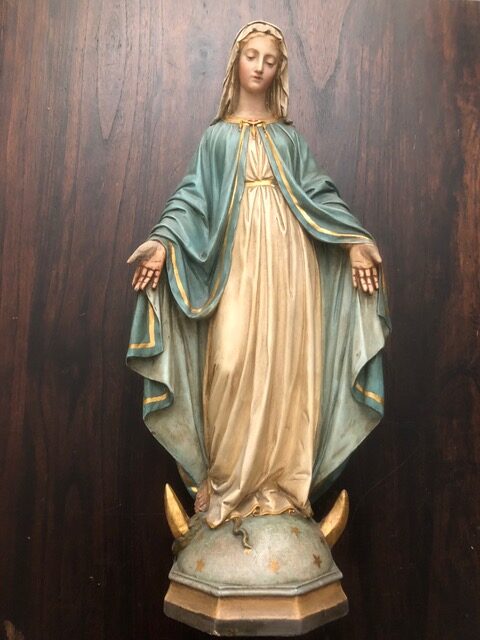
Memorials have also been placed in the sanctuary, such as those of Augustyn Kordecki (1603–1673), abbot of the monastery for many years and defender of the sanctuary against the Swedish troops in 1655, Stefan Wyszynski (1901–1981), Archbishop of Warsaw-Gniezno (1948–1981), appointed cardinal in 1953, and Pope John Paul II. There are also statues of angels and a large statue of the Immaculate Conception of Mary.
The pilgrimage site also has its own radio station, “Radio Jasna Gora”.
Processions take place on 3 May, 15 August, 26 August, 8 September and 8 December, among other dates.
The shrine is open daily.
ACCESSIBILITY
Częstochowa lies on the river Warthe (Warta) and is surrounded by forests. The shrine is located on a mountain, with the city below it.
Address: Ul. O.A. Kordeckiego 2, 42-225 Częstochowa.
More information can be found at www.jci.jasnagora.pl.
Jasna Góra's radio station can be found at the internet address www.rjg.pl.
Experience

A good friend of mine is visiting the Polish Marian shrine of Czestochowa. When she is at the shrine and visits Mary, she will bring a prayer card for me. The text, which is very significant to me, reads:
“Prayer to Our Lady of Czestochowa. Holy Mother of Czestochowa, you are full of grace, goodness, and compassion. I consecrate myself to you, my thoughts, my words, my actions, my soul, and my body. I earnestly ask for your blessings, especially to pray for my salvation. Today I dedicate myself entirely to you, good Mother, with body and soul amidst joy and suffering. I ask you for myself and others to obtain your blessings today on earth and in the future, eternal life in heaven. Amen. Our Lady of Czestochowa, Queen of Poland, pray for us.” This text is an extra encouragement for me to visit Mary in Czestochowa.
The most visited Marian shrine in Poland is Częstochowa. I've heard that around 4 million visitors come here per year. So, the Black Madonna attracts a lot of attention. I've heard from acquaintances how remarkably impressive it is there. I've also experienced this by reading about it, looking at photos, seeing impressions on television and consulting the internet. Therefore, Częstochowa is high on my list for a pilgrimage through Poland to visit.
The tall tower of the basilica stands majestically, watching those who approach. Well, that amounts to several million annually. Today, I'm fortunate enough to get closer to the tower and get acquainted with this sanctuary of national and international fame.

In the basilica, I am moved by the Baroque decorations. What a beautiful interior! The pilgrims come for the Black Madonna, and I do too. My interest is first drawn to the chapel where the icon can be visited, and then I admire the altarpiece of the Mother of God of the Rosary. I also stand for a long time before the high altar which depicts the Assumption of Mary. Subsequently, I take a walk around the basilica and pause at the chapels, statues, paintings, and frescoes. What a building!
During the tour of the basilica, I notice how much has been preserved. This country has suffered enormously from several wars, claiming millions of lives and countless buildings.
The basilica's tower is 106 metres high and can be climbed, but I'll leave the climb of over 500 steps to others. My age, but especially my lungs, impose physical limitations.
In the early morning I arrived at the vast domain of Jasna Góra and late in the evening is the departure.

Environment
Travelling from Katowice, the birthplace of the future Pope John Paul II, to Czestochowa means travelling 92 km north.
Departing from Krakow to arrive in Czestochowa is travelling 158 km to the northwest.
Travelling 187 km north from the pilgrimage site of Kalwaria Zebrzydowska will bring you to Częstochowa.
Travelling from Warsaw to Częstochowa involves travelling 220 km to the southwest.
From the pilgrimage site of Lichen Stary, go 268 km south-east to arrive in Częstochowa.
~~~

 Nederlands
  English (UK)
  Deutsch
  Français